
Can you use Instinct for website building?
Thinking of Instinct for website building? Treat drafts and the running site as two jobs, and ask four questions before trusting any assistant.
AI Engineer, Viithiisys

The job behind the search: a website that takes bookings
Someone typing "instinct for website building" usually wants one thing: a working site, without hiring a team, and they are asking whether an AI assistant can produce it. The short answer is that a website is two jobs. One is drafting. The other is running a system.
[Illustrative example] Picture a hypothetical physiotherapy clinic with two locations. The owner wants five pages, an online booking form, a deposit taken by card and a way to change opening hours without calling anyone.
The drafting half is the words and the page plan. The running half is everything that must keep working on a Tuesday night when nobody is watching: the booking that has to reach the calendar, and the payment that has to match it.
This post sits in our AI workflow automation work, and it is written for the founder with no senior engineer in the building. It covers which half an assistant plausibly helps with, what to ask before trusting it with the other half, what we would build and what drives the cost.
Provenance: Viithiisys sells web app development and AI workflow automation, so weigh this accordingly. Instinct is not our product and nobody has given us its documentation, so this post makes no claim about what it does. It rests on public standards and vendor documentation, with no delivery records behind it.
Which parts of a website are drafting work
Drafting work is anything a person reads and approves before it goes live. Page copy, a site map, title tags and meta descriptions, image alt text and a first pass at FAQs all fit that description.
This is the part where an AI assistant plausibly earns its place, because a wrong draft costs you a re-read. Nothing breaks. You stay the editor.
Google's guidance on AI-generated content (Google Search Central, 2023) says it rewards helpful content however it is produced, and that using automation mainly to manipulate rankings breaks its spam policies. Its March 2024 update added a named policy against scaled content abuse (Google Search Central, 2024). So a draft is a starting point for someone who knows the business.
For the clinic, that means the owner corrects the treatment descriptions and the cancellation terms by hand. Those facts live in the owner's head, so the owner checks them.

Why drafts alone do not give you a working site
A finished set of drafts still has to be designed, built, connected and hosted, and each of those steps can fail quietly. That gap is where the obvious fix lets people down.
The obvious fix is to paste the drafts into a hosted site builder such as Wix or Squarespace, or to ask an assistant to generate the whole thing. Both have an honest case. A hosted builder bundles the hosting and an editing screen into one subscription, and for a five-page brochure site that is often the right answer.
The trouble starts when the site has to do something. A booking has to land in the calendar the front desk uses. A deposit has to be matched to that booking. Somebody has to hear about it when either step fails.
A draft that is wrong costs you a re-read; a booking that never reached the calendar costs you a customer who turned up.
Four requirements to ask any AI assistant about
Before you hand the running half of a site to any assistant, Instinct included, ask four things and look for the answers in its product documentation. These are questions to put to a vendor. We make no claim about how any product answers them.
| Requirement | Ask this | What goes wrong if nobody asks |
|---|---|---|
| Custom design | Can it work from your brand files and produce pages you can edit later? Who tests them against WCAG 2.2? | A site that looks like every other one, with contrast and keyboard problems found after launch |
| CMS | Where does the content live, and can a non-technical person change a price alone? | Every small edit becomes a request, or hand edits vanish when a page is regenerated |
| Booking or payment integration | Does it connect to your booking system and payment provider, and what happens when a sync fails? | Double bookings, and deposits with no appointment attached |
| Hosting ownership | Whose name is on the domain, the hosting account and the code? Can you export everything? | You cannot move, and one lapsed subscription takes the site down |
Custom design and accessibility
Ask whether the output starts from your brand or from a stock layout, and who tests it. Custom design means the pages are drawn for your content and your customers, and that somebody checked them on a phone.
Testing has a published yardstick. WCAG 2.2, the accessibility standard from the W3C (2023), sets checks such as text contrast, keyboard access, visible focus and the minimum size of a button you tap.
Ask which of those checks the tool runs itself and which are left to you. Then ask what you receive at the end: editable design files and page templates, or only the finished pages.
For the clinic, the practical test is simple. Can a patient with a screen reader, on an older phone, get from the home page to a confirmed appointment? If nobody has tried, nobody knows.
CMS: who edits the site after launch
A CMS, or content management system, is the editing screen where someone changes text and images without touching code. Ask where the content is stored and whether your office manager can change a price alone.
Named options help you compare. WordPress is open source and can be self-hosted. Webflow and Squarespace are hosted products with their own editors.
Each choice trades control against upkeep. A self-hosted CMS gives you the files and the database, and it also gives you the updates to apply. A hosted one handles the updates and keeps the content on its platform.
Ask one more thing of any assistant that generates pages. If it regenerates a page next month, what happens to the edits a person made by hand in between? Get that answer in writing before the clinic's holiday hours depend on it.
Booking and payment integration
Ask whether it connects to the booking system you already use, and what happens when a sync fails. The second half of that question matters more.
Payment providers tell your site about a payment by sending a webhook. A webhook is a message one system sends another when something happens. Stripe's webhook documentation says an endpoint can receive the same event more than once, and tells developers to guard against duplicates and verify each message's signature.
So somebody has to write the handling for a message that arrives twice, late, out of order or never. Ask who that is.
If you take cards, also ask who carries the duties under PCI DSS, the card industry's security standard (PCI Security Standards Council, v4.0.1, 2024). Using a provider's hosted payment page reduces your share of that work. It does not remove it.
Hosting ownership and the exit
Ask whose name is on the domain, the hosting account, the code and the analytics. If the answer is the vendor's, you are renting your website.
Then ask what an export contains. A folder of HTML files is an export. So is a full copy of the content, the images, the redirects and the form data, and the second kind is the one you can rebuild from.
Our recommended default is that the business holds the domain registration and the hosting account in its own name, with the builder added as a user. That is our advice and no industry rule requires it. Plenty of firms run happily on a hosted platform they could never export.
The trade-off is convenience now against freedom to leave later. For the clinic, a lapsed vendor subscription should never be the reason patients cannot book.
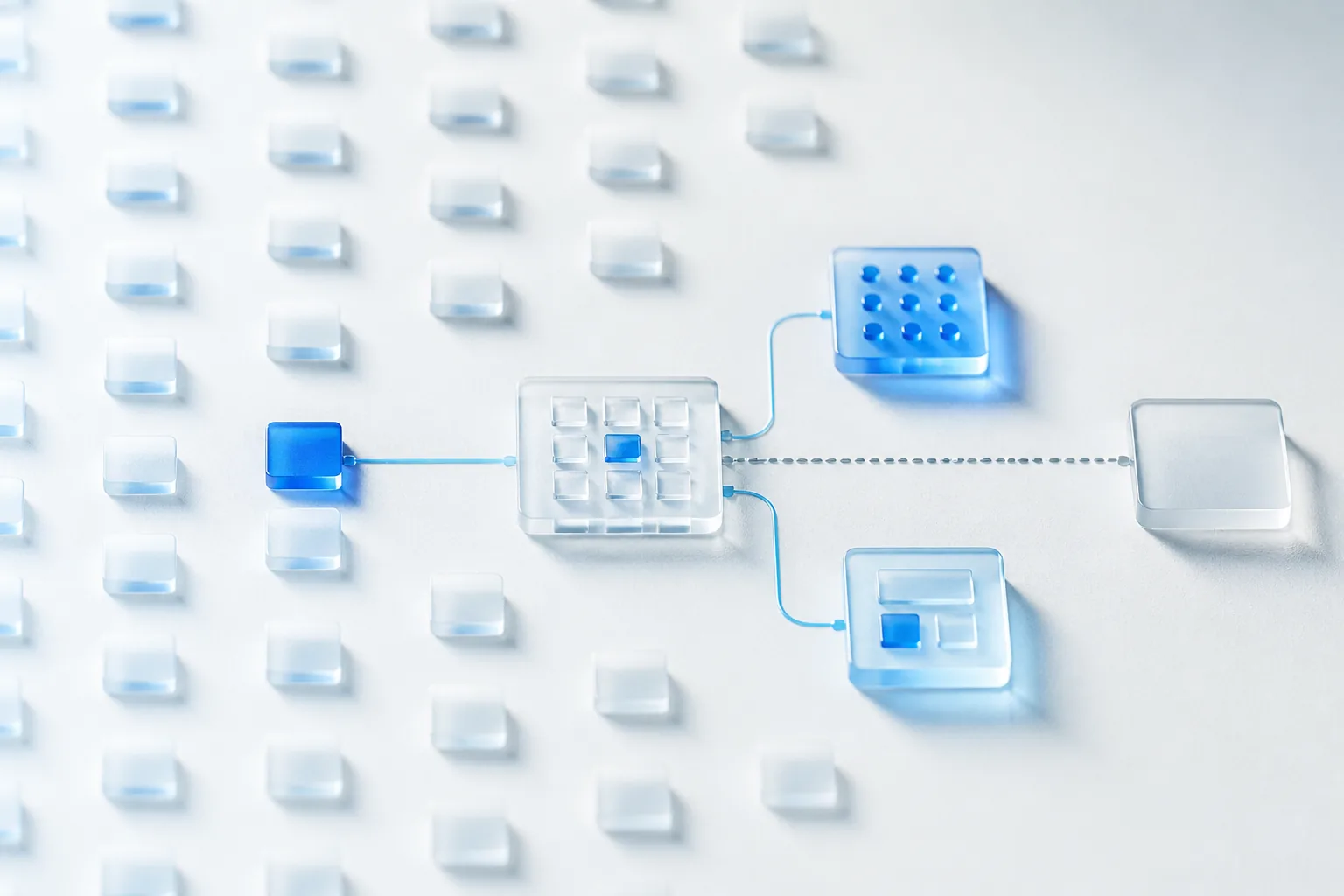
The build we recommend for a booking-led site
[Reference build] For a site like the clinic's, we recommend a small built system, with an assistant used for drafts only. This is a proposed design for a booking-led service site. It describes no client engagement and carries no results.
- Drafts. An assistant produces page copy and the site map. The owner edits and approves every page.
- Design and pages. A designer builds the pages on a CMS the staff can edit.
- Booking. The form writes to the booking system the front desk already uses, through that system's API. An API is the documented way one program talks to another.
- Payment. A hosted payment page takes the deposit. A small service matches each payment to its booking.
- Exceptions. Any booking without a matched payment, or payment without a booking, goes to a named person's inbox the same day.
Step 5 is the part a demo never shows. If the scope can be agreed up front, this shape fits Moonship, our fixed-scope build. If the booking logic is unusual, read how we approach web app development for sites that behave like software.
AI for the drafts, plain rules for the bookings
Use a language model where the input is messy language, and plain rules where the answer must be the same every time. That split is our recommendation, and other teams draw the line elsewhere.
On this site, AI fits the copy drafts and the sorting of free-text enquiries, such as "can I bring my dog to the appointment?", into the right inbox. Rules fit slot availability, deposit amounts, confirmation emails and refunds.
A slot is free or it is taken. No model needs to form an opinion on that, and a rule is cheaper to run and easier to test.
The honest boundary is that a model can give different output for the same input. So anything it produces that touches money or a customer's calendar should pass a rule or a person first.
Where enquiry volume justifies it, that sorting step is what AI workflow automation covers. Wiring a model into a booking tool you already own is AI integration work, and that page explains what it involves.
Cost drivers, and the work that gets underestimated
The cost of a small business site depends mostly on what the site connects to, and far less on how many pages it has. We do not publish prices, because work is scoped after a discovery call, so here are the drivers.
- Integrations. Each system the site talks to adds build and test work. Older booking tools without a documented API add the most.
- Exceptions. Handling the failed sync and the duplicate payment can take longer than building the main flow.
- Content. Somebody has to supply real photos and real prices, and that is usually the owner.
- Design depth. A custom design with accessibility testing costs more than a template with your logo on it.
- Running costs. Hosting, the CMS plan, payment fees and someone to apply updates all continue after launch.
The item to look for on any quote is ownership after launch: who gets the alert at night, and who renews the domain. If nobody on your side can judge a quote like this, that review is what a fractional CTO does on a part-time basis.
Send us the booking or payment step that keeps failing
If part of your site already jams, start there instead of with a rebuild. Describe the step in the broken workflow assessment: which form, which system it should reach, what happens when it fails and who finds out.
We will tell you whether it looks like a fix to what you have or a new build, and which questions to put to any assistant you are considering.
For the clinic in this post, the answer would be short. Let an assistant draft the five pages, and have a person own the Tuesday-night booking.
Sources
- Google Search Central, "Google Search's guidance about AI-generated content" (2023): https://developers.google.com/search/blog/2023/02/google-search-and-ai-content
- Google Search Central, "What web creators should know about our March 2024 core update and new spam policies" (2024): https://developers.google.com/search/blog/2024/03/core-update-spam-policies
- W3C, Web Content Accessibility Guidelines (WCAG) 2.2 (2023): https://www.w3.org/TR/WCAG22/
- Stripe, webhook documentation: https://docs.stripe.com/webhooks
- PCI Security Standards Council, PCI DSS v4.0.1 document library (2024): https://www.pcisecuritystandards.org/document_library/
FAQ
- Can an AI assistant build a whole website?
- It depends on the site and the product, so check the product's documentation instead of a demo. Drafting copy and a page plan is plausible assistant work with a person editing. A site that takes bookings or payments also needs integrations, failure handling, a CMS and hosting, and someone must own each one.
- What should I ask before using an AI assistant to build my website?
- Ask four things and look for the answers in the product documentation. Can it produce a custom design you can edit later? Where does the content live? Does it connect to your booking and payment systems, and what happens when a sync fails? Whose name is on the domain and the hosting account?
- Is AI-written website copy bad for SEO?
- Google's 2023 guidance says it rewards helpful, reliable content however it is produced, and treats automation used mainly to manipulate rankings as spam. So AI-drafted copy is acceptable when a person who knows the business corrects it and adds what only the business knows. Nothing here promises a ranking.
- How much does a small business website cost?
- Cost depends mostly on what the site connects to. A brochure site on a hosted builder sits at the cheap end. Booking and payment integrations, custom design, accessibility testing and failure handling add build work, and hosting and payment fees continue after launch. Viithiisys scopes work after a discovery call.